A House in The Sky Book Review: Captivity to Courage
“In my mind, I built stairways. At the end of the stairways, I imagined rooms. These were high, airy places with big windows and a cool breeze moving through. I imagined one room opening brightly onto another room until I’d built a house, a place with hallways and more staircases. I built many houses, one after another, and those gave rise to a city — a calm, sparkling city near the ocean, a place like Vancouver. I put myself there, and that’s where I lived, in the wide-open sky of my mind.”
Amanda Lindhout’s experience as a hostage in Somalia is an unforgettable journey of survival and resilience. She is held captive for four hundred and sixty days by militants from the Hizbul Islam fundamentalist terrorist group. In the memoir A House in the Sky, readers learn of the unimaginable hardships, emotional challenges, and physical abuse she was forced to endure in what was the darkest year of her life. Amanda didn’t think she was going to survive. Her book is a true testament to the power of hope and the strength of the human spirit.
In today’s post, I wanted to share Amanda Lindhout’s story and my thoughts on her memoir. I think she is an amazing person, and I found myself inspired by the depths of her character. The raw honesty and profound insights she harbors in her soul as she transitions from being a curious traveler to an employed journalist, and then the unfortunate captive in a foreign land, are beyond heart-wrenching. The emotional roller coaster this memoir took me on is not something I’m likely to forget. The psychological impact of her ordeal leaves a feeling of triumph. Her story isn’t just about survival but also about the human capacity for resilience and one woman’s ability to never lose hope.
I know I’ve not posted as much as I had hoped or planned this semester, but school has been taking up all my free time. I’m doing the best I can to simply keep my head above water, which is why there have been limited posts. Now that the semester is at a close, I plan on getting back to posting a bit throughout the summer. My finals are approaching in the next couple of weeks, so I should have some free time to dive into some writing. That will be a good thing because I have so many drafts I need to share with everybody! I thought this book review would be a great way to start because it was probably one of the most shocking memoirs I’ve ever read in my entire life. I still cannot believe it.
Special note: All book reviews will contain spoilers. This is so I can discuss the book in depth without having to be vague about certain events, details, or topics that occur in the story. Please be aware that this book does have a trigger warning. The memoir contains violence, sexual assault, foul language, abuse, medical neglect, terrorism, and religious indoctrination. This book, to say the least, is not light reading.


To truly understand a story, one must start from the beginning. Amanda Lindhout grew up in a financially struggling and troubled household. Her parents divorced early on, causing significant upheaval in her life. As a child, Amanda felt heartbroken watching her mother struggle to support the family. It wasn’t long before Russell, an abusive and often drunken boyfriend, was introduced into their lives, making the home even more unhappy. It took years before he was out of the picture. Despite these challenges, Amanda never blamed her mother.
“My mother was a beautiful woman, but she was also fragile and vulnerable. She struggled to provide for us, often working multiple jobs to make ends meet. I remember the nights when my mother would come home exhausted, her hands rough from cleaning houses. She did everything she could to keep us afloat, but it was never enough. Despite the hardships, my mother always tried to create a sense of normalcy for us. She would read to us, tell us stories, and make sure we felt loved, even when the world around us was falling apart.”
Amanda often escaped her troubled home life by immersing herself in the National Geographic magazines that she began collecting as a child. She fell in love with the captivating stories and stunning photographs, which is where her lifelong obsession with traveling first started. Her greatest dream was to explore the world firsthand, just like the captivating images in the magazines. Nothing was more desired.
A passion for travel ignited in Amanda’s soul as she eagerly collected every copy of National Geographic she could find. Each magazine fueled her dreams of exploring distant lands. She spent years dreaming of being able to travel. The vivid stories and breathtaking images offered her hope and a vision of a brighter future. Amanda held onto these dreams. One day, they would come true. Over the years, her collection grew. Each new issue is a stepping stone towards her ultimate goal. They gave her a sense of purpose. A reason to work hard.
“Sometimes I would fan them out like I’d seen on the coffee tables at the homes of some of the fancier kids from my old school. The world arrived in waves and flashes as a silvery tide sweeping over a promenade in Havana, or the glinting snowfields of Annapurna.”
I find Amanda’s personality quite interesting because there were a lot of goals in life that she set out to achieve and constantly planned to do. If you ask me, the biggest thing I’ve taken away from her story is that she always gets what she wants. That is how determined a person Amanda is at her core. The girl gets it done. That is simply the truth. I can only admire and marvel at such a human because it’s a reminder of what we each are capable of. The dedication her plans required is something everyone should be striving for. Hard work truly pays off.
Her first trip abroad was when she was twenty years old. After working hard, busting tables in a restaurant bar as a cocktail waitress, she could afford her first chance at traveling, which opened up tremendous opportunities. Throughout her twenties, Amanda managed to travel through Latin America, Asia, and Africa. These experiences marked her forever and inspired her to start a career as a journalist.
By the time Amanda was twenty-four, she was able to use the money she had saved working to fund her freelancing trips to report on high-conflict areas. The first years of her journalism career were often spent in Kabul. The largest city in Afghanistan. Eventually, in 2008, she began working in Iraq as a journalist for Press TV, an Iranian state-run news outlet. Despite the controversial nature of Press TV. A network whose reputation for state propaganda was often criticized and not very respected. Amanda was making a small name for herself.
During her early freelancing career, Amanda was a self-starter and a motivated person. She had grown into someone constantly on the move, seeking new adventures. The bravery to venture into these notoriously risky areas without any institutional backing was a bold move that proved to be effective. Her journalist career blossomed into something promising, but the danger was all too real.
“All the things I couldn’t know sat somewhere embroidered into me. I don’t only long for the thrill of being in the middle of a war, I must understand it; I must make other people understand. I must try desperately to absorb all information I can about the Middle East. I want to excel. I want to speak articulately about the politics of the Middle East and its religion. With awareness come responsibility and choice.”
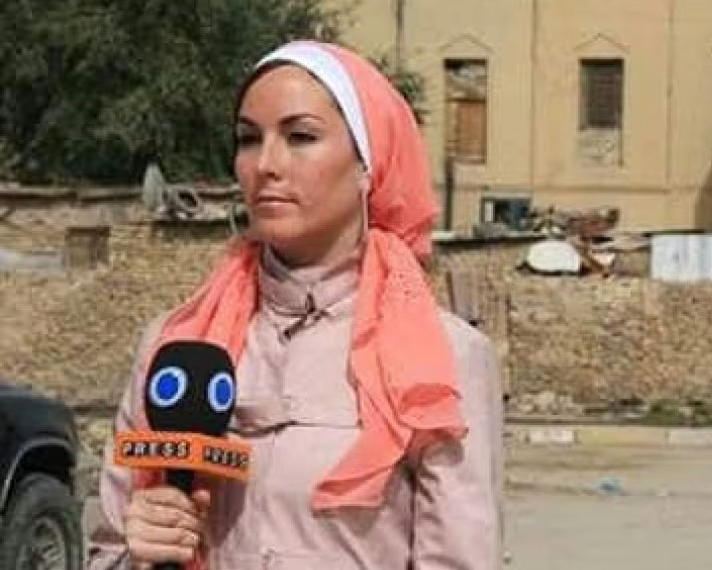


Amanda made the fateful decision to travel to Somalia in 2008. A country ravaged by civil war, lawlessness, and famine. An area that was reported to be one of the world’s most dangerous places. After covering numerous stories in Iraq and Afghanistan, this seemed to be the next logical step in her pursuit of meaningful, high-impact journalism. The decision was a gamble. Somalia had no functioning government, no foreign press corps, and no safety net. That was exactly the point. Amanda believed that journalism could be a force for good.
She wasn’t chasing fame or clicks. Amanda was chasing the truth. Somalia represented a place where her voice could matter. The country faced a significant humanitarian crisis and media blackout. Bearing witness is a courageous act in itself. She wanted to be able to report on what was happening so the world could see it. Amanda wanted to make a difference. In her memoir, she reflects on how journalism gave her a sense of purpose. The people of Somalia deserved to have their voices heard. That was the mission and point of her travels.
The unfortunate reality, however, is that Amanda underestimated the chaos of Somalia despite all of her research, planning, and precautions. It’s a sobering reminder that even the most prepared can’t control everything. This is especially true in places where depravity reigns. The limits of human foresight nearly killed her. She stepped into a place most people would never dare to go. Driven by a belief that stories from the margins matter. That kind of courage, which is flawed, human, and deeply intentional, is what makes her powerful story resonate.
“I, too, was carrying around my own fate. Maybe not quite fixed to the point of inevitability but waiting…Somalia was a place where no one else was going. That was the appeal. It was dangerous, yes, but it was also a blank slate. A place where I could prove myself. I knew it was risky. I knew the warnings. But I also knew that if I didn’t go, I’d always wonder what I might have done there. What stories I might have told. I was nervous, but I told myself that fear was part of the job. That if I wanted to be taken seriously, I had to go where others wouldn’t.”
Amanda arrived in Mogadishu with her ex-boyfriend Nigel Brennan, an Australian photojournalist, on August 21st, 2008. Nigel was a man with whom she shared a complicated personal and professional relationship. They originally met in Afghanistan, then reconnected in Kenya shortly before their trip to Somalia. Despite their romantic relationship fading, they still relied heavily on each other for support when they were out in the field. They were extremely close friends. Nigel agreed to join Amanda after she pitched the idea of a humanitarian piece, specifically reporting on several brand-new hospitals and a women’s education program that had been founded just outside the capital city. The two did have serious reservations at first, but pushed those aside to focus on the good they could accomplish rather than their own fear.
Once they arrived in Somalia, the two checked into the Shamo. The hotel was one of the few places in Mogadishu that would accommodate foreign visitors. Armed guards and barbed wire fences surrounded the building to offer guests a semblance of protection. Amanda had done her research to be as safe as possible. She hired local fixers to provide essential on-the-ground support to help navigate the complex environment and arranged for armed escorts to be with them every step. They believed the story was worth it. They knew the risk.
Just two days after their arrival, an unimaginable disaster struck on the morning of August 23rd. The pair set out with their translator, Abdifatah Elmi, and two local drivers. They were headed to a nearby village to begin their reporting when their vehicle was ambushed just outside the city. This was a disaster. The group was forced out of the car at gunpoint and driven into the unknown within minutes.
That moment marked the end of Amanda’s freedom. The start of a terrifying fifteen-month-long ordeal that would test every limit of her body, mind, and spirit. She had spent years chasing stories in war zones, but nothing had prepared her for the brutal reality of being the story. There was no time to process, no time to plead. The story Amanda had come to tell was replaced by the one she would have to live.
“We were driving through a dusty stretch of road, the sun already high and hot. I was trying to focus on the story, but something in my chest felt tight. I told myself it was just nerves. The car jerked to a stop. Men with guns surrounded us. I remember the sound of shouting, the slam of doors, the sudden, terrifying clarity that we were being taken. I thought: This is it. This is the moment everything changes. I was right.”


This next section is going to be harder to discuss and cover. I want to write about it respectfully with the weight it deserves. The first hours of Amanda Lindhout’s captivity were filled with confusion, fear, and disbelief. She describes how quickly her sense of reality began to shift. The men who had taken them were young, armed, and unpredictable. They mainly spoke Somali but also broken English. It became clear that Amanda and Nigel were now their bargaining chips. The captors demanded millions in ransom. Money that their families didn’t have.
“Kidnappings happened, my parents were told, but they also ended. This was meant as reassurance. So was another point the agents made, offering a first bit of hard comfort in what would turn into months of it: Nigel and I were now commodities. The kidnappers spent money to catch us and keep us. They’d made an investment. It was in their best interest to keep us alive. If they killed us, it would be their loss, too.”
The weight of that realization was crushing. The conditions were ruthless from the start. Amanda and Nigel were kept in dark rooms with no windows. They were given little food, no medical care, and were often separated. These men were not trained soldiers. They were teenagers and young adults. Many of these boys were armed, radicalized, driven by poverty, ideology, and the promise of ransom. Amanda described them as unpredictable and volatile. These insurgents often switched between moments of eerie calm and then into terrifying aggression.
Neither knew what happened to the guide and drivers they had been traveling with. Amanda was treated with cruelty. She was beaten, starved, and isolated. The captors kept her alone for days on end, denying her even the most basic hygiene. Her physical health deteriorated rapidly. The captors would mock her, threaten her, and use her fear as a tool of control. The psychological torment was severe.
One of the disturbing aspects of Amanda’s captivity was their attempts to force her to convert to Islam. They gave her a Quran, pressured her to pray, and insisted she adopt Islamic customs. Amanda followed through with all of this and converted to appease and soften their treatment of her. She was facing significantly harsher abuse than other captives because she was just “an evil and untrustworthy woman.”
“I’d spent my life believing that people were, at heart, kind and good. This was what the world had shown me.[…] If humans could be this monstrous, maybe I’d had everything wrong. If this was the world, I didn’t want to live in it. That was the scariest and most disabling thought of all. I felt fear, but also something else, something missing. A sudden absence of conviction…”
Amanda’s resilience in those early days is nothing short of extraordinary. Her intelligence in getting her captors to see her as human and connect with them was expert. To have these men see themselves in her in some small way is quite genius. To get them to care about her well-being was a priority she didn’t overlook. Converting to their religion wasn’t a surrender. It wasn’t defiance. This was simply a chess move. It was a way for her to feel less foreign; in feeling less foreign, she could be less afraid. Amanda also knew that in Islam, a believer shouldn’t kill a fellow believer, and a believing slave is given more lenience than an unbelieving slave. There was nothing she wouldn’t do.
Fresh new problems grew as the months dragged on and ransom negotiations stalled. The money wasn’t coming in, making the captors angrier every day. Amanda’s situation worsened. She was repeatedly raped by multiple captors daily. An unfortunate trauma she recounts with heartbreaking honesty in her memoir. The sexual violence was relentless and dehumanizing. Being treated like property and not a person is difficult to imagine. Nobody should have to endure such pain. I can’t even fathom the strength it took for her to stay alive.
The days slowly dragged on as Amanda was subjected to torture. She was tied up for days at a time, beaten with rifle butts, and threatened with death. They would constantly make her think she was about to be beheaded by circling her holding large machete-type weapons. At one point, she attempted to escape but was recaptured quickly and punished severely. Her captors shaved her head, beat her, and used her body roughly. The physical pain was unbearable, but the loss of dignity was even more profound. She was desperate to hang onto anything.
I want to end this book review by discussing something that is hard to understand but makes perfect sense given the circumstances. It truly shows what a strong, smart, and emotionally intelligent woman Amanda was at her core. I don’t want to speak for her but how I understand it. She did start to sympathize with her captors to some degree. To see how their environment made them the evil men they were.
“I began to nurture something I’d never expected to feel in captivity. A seedling of compassion for those boys. I told myself that they were not monsters. They were products of war and poverty. They were kids who’d grown up surrounded by guns and propaganda, that violence was power. The boys who had never known a world without war. They were not much older than teenagers, and yet they held the power of life and death over me. They laughed at my pain, mocked my fear, and yet I could see, sometimes, a flicker of uncertainty in their eyes. I clung to those flickers. I told myself that if they could doubt, they could change. I began to pray for them. Not because I forgave them, but because I needed to believe in something bigger than my pain. I needed to believe that even the worst people could be touched by grace. That maybe, someday, they would remember me not as a victim, but as a person who saw them, who tried to understand them.”
Amanda refused to surrender her humanity in the face of sustained dehumanization. She tried to understand these men. It was an incredible act of psychological and moral defiance. A part of her soul that she never surrendered, no matter what. It just didn’t matter. Her sympathy for her captors wasn’t rooted in denial or weakness but in a deep, conscious effort to understand all the forces that shaped them. By choosing to see them through context rather than condemnation, she reclaimed a sense of agency in a situation designed to strip her of it. A survival strategy, a philosophical stance, and a radical assertion of dignity in the face of cruelty. It reveals a steady and unbroken heart, but one also expanded by suffering, capable of holding complexity where others might only find hatred. I’m absolutely amazed by Amanda Lindhout.
This is where I want to leave my review. She defied all odds to come out swinging, and that’s all that truly matters in the end. This was just one horrible chapter in a life well-lived. This doesn’t define Amanda’s story. Through donations, family effort, and supporters, the captors were paid their ransom money. She and Nigel were rescued. The captors were later caught, put on trial, and sentenced for their crimes.
Discover more from The Chronicles Of History
Subscribe to get the latest posts sent to your email.
That poor woman.
Very much so. I am amazed by her and how she has conducted herself since there. She didn’t let them take her power away!
Her story is terrible, but also inspiring. And a testament to just how much the human spirit can endure and survive.
Best wishes, Pete.
Right. I could never imagine going through what she did. Yet she didn’t allow them to take away her kindness and big heart.
A very strong woman and individual. I pray she can get over the horrors and nightmares she faced.
The very strongest!
What a journey from a terrible experience to something better
I know! She absolutley amazed me!